

From the spice-scented shores of the Indian Ocean to the ancient volcanic caldera where the Big Five roam — the Ngorongoro safari from Zanzibar is a journey between two of Africa’s most iconic worlds.
Introduction
Stand on the rim of Ngorongoro Crater at first light and the world below you is still wrapped in mist. The crater floor — 260 square kilometers of primordial savannah, gleaming lake margins, and fever tree forest — lies 600 meters beneath your feet, hidden and breathing. Then the mist begins to thin, and shapes emerge: the dark mass of a buffalo herd on the open plains, the silver glint of the soda lake, a solitary elephant moving through golden grass. By the time your vehicle begins its descent, the sun has broken fully over the crater wall, and Africa has announced itself with characteristic, overwhelming magnificence.
Less than 24 hours earlier, you were in Zanzibar.
The Ngorongoro safari from Zanzibar is one of East Africa’s most compelling travel combinations — a journey that moves between two of the continent’s most celebrated and utterly distinct environments. Zanzibar offers the Indian Ocean at its most beautiful: white coral sand, warm turquoise water, the ancient Swahili culture of Stone Town’s UNESCO-listed labyrinth, and the sweet fragrance of cloves and cinnamon that has drawn traders from across the world for over a millennium. Ngorongoro offers something altogether different — a concentrated encounter with wild Africa of breathtaking density and intimacy, set within a landscape shaped by geological forces three million years in the making.
This article is your complete guide to the Ngorongoro safari from Zanzibar: the journey, the crater, the wildlife, the best times to visit, how to structure your itinerary, and everything that makes this dual experience one of the finest journeys available to the modern traveler.
Understanding Ngorongoro: The World’s Largest Intact Volcanic Caldera
The Ngorongoro Crater is the centerpiece of the Ngorongoro Conservation Area — a 8,292-square-kilometer UNESCO World Heritage Site in the Crater Highlands of northern Tanzania. The crater itself was formed approximately three million years ago when a colossal volcano, believed to have once rivaled Kilimanjaro in height, erupted so violently that its peak collapsed inward upon itself, creating one of the largest intact calderas on Earth.
What followed over the subsequent millennia was remarkable. The crater’s enclosed geography — ringed by walls rising between 400 and 600 meters — created a self-sustaining ecosystem largely independent of the surrounding landscape. Permanent water sources, mineral-rich soils, and reliable annual rainfall created conditions in which wildlife populations could thrive in extraordinary concentrations. Today, the Ngorongoro Crater supports an estimated 25,000 to 30,000 large animals, including one of Africa’s densest populations of predators, making it the single most productive game-viewing arena on the continent.
Unlike most African national parks and game reserves, the Ngorongoro Conservation Area is a multi-use conservation model — one of the first and most successful in Africa. The indigenous Maasai people, who have inhabited the crater highlands for centuries, retain grazing rights for their cattle within the conservation area, creating a landscape where traditional pastoral life and wildlife conservation coexist in a delicate, managed equilibrium. This cultural dimension adds a layer of richness to the Ngorongoro experience that purely protected wildlife areas cannot offer.
From Zanzibar to Ngorongoro: The Journey
The geographic distance between Zanzibar and Ngorongoro is approximately 620 kilometers. Despite this, the journey between the two is efficiently managed through Tanzania’s well-developed domestic aviation network.
By Air
The most practical route from Ngorongoro safari from Zanzibar runs via Kilimanjaro International Airport (KIA), which receives multiple daily scheduled flights from Zanzibar’s Abeid Amani Karume International Airport. Flight time between the two airports is approximately 1 hour 20 minutes. From Kilimanjaro, road transfers to the Ngorongoro crater rim take approximately 2.5 to 3.5 hours, passing through the market town of Arusha and into the highlands of the Crater Highlands — a journey of progressive scenic revelation as the landscape transitions from lowland acacia scrub to montane forest and open moorland.
Some operators arrange direct light aircraft transfers from Zanzibar to Arusha Airport, from where the crater transfer continues by road. Coastal Aviation and Auric Air both operate relevant connections. Total door-to-door travel from Zanzibar to a crater rim lodge typically takes 4 to 6 hours depending on connection timing.
The Road from Arusha
The road journey from Arusha to Ngorongoro passes through some of northern Tanzania’s most evocative landscapes — skirting the base of Mount Meru, cutting through Maasai boma communities, climbing through the cool mountain air of the Crater Highlands past coffee plantations and subsistence farms. Many operators incorporate a brief stop at the Maasai Market in the town of Mto wa Mbu or a viewpoint overlooking Lake Manyara on this transfer, adding cultural and scenic value to what might otherwise be a purely utilitarian road journey.
Wildlife in the Crater: A Complete Big Five Destination
Ngorongoro’s enclosed geography makes it one of the only places in Africa where all five members of the Big Five — lion, leopard, African elephant, Cape buffalo, and black rhinoceros — can be realistically encountered in a single game drive. This extraordinary concentration of iconic species within a defined and navigable space is the crater’s defining characteristic as a safari destination.
Lion
Approximately 60 to 70 lions inhabit the Ngorongoro Crater permanently, organized into several well-studied prides. The crater’s isolation has produced a genetically distinct population characterized by particularly dark-maned males — among the most visually striking lions in Africa. Prey is abundant and varied, with wildebeest, zebra, buffalo, and gazelle available year-round. Lions are encountered on nearly every crater game drive, typically resting on the open Malanja grasslands or moving purposefully along the crater’s marsh edges at dawn.
African Elephant
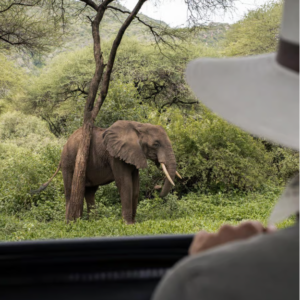
Large bull elephants descend regularly into the crater from the forested outer slopes and are among the most memorable sightings available to visitors. Ngorongoro’s bulls are notably large, with impressive tusks reflecting the mineral richness of the crater vegetation. The Lerai Forest — a stand of fever tree acacias on the southern crater floor — is a reliable elephant habitat and one of the most photographically beautiful settings in the crater.
Cape Buffalo
Buffalo are among the most numerous large mammals in Ngorongoro, with herds of several hundred animals regularly visible on the open grasslands. Dense aggregations of buffalo — calves clustered at the center, massive sentinel bulls patrolling the perimeter — provide some of the most dramatic wildlife photography opportunities in the crater. Lion-buffalo interactions are a regular occurrence, particularly in the early morning hours when predator and prey alike are most active.
Black Rhinoceros
Ngorongoro Crater holds one of Africa’s most important and carefully protected black rhino populations — approximately 20 to 30 individuals, representing a conservation triumph given the species’ catastrophic decline through poaching in the 1970s and 1980s. The open grassland of the crater floor makes rhino sightings significantly more achievable here than in the dense bush habitats where the species is typically found elsewhere. While sightings are not guaranteed on every drive, the probability within Ngorongoro far exceeds that of virtually any other destination on the continent.
Leopard
The leopard is the most elusive of the Big Five in the crater — secretive, largely nocturnal, and most often found concealed in the fever trees of Lerai Forest or resting on rocky outcrops along the inner crater wall. Experienced guides who know the crater intimately dramatically improve the odds of a sighting. When a leopard is found — draped languidly over a branch in the golden afternoon light, the crater walls rising behind it — the encounter is among the most extraordinary in African wildlife.
Beyond the Big Five
Ngorongoro’s wildlife extends far beyond the flagship species. Spotted hyenas are extremely numerous, and their complex social dynamics are on constant display. Cheetah, serval, golden jackal, bat-eared fox, hippopotamus, flamingo, crowned crane, secretary bird, kori bustard, and over 500 bird species complete a biodiversity picture of extraordinary richness. The crater’s varied habitats — open grassland, freshwater marsh, alkaline lake, fever tree forest, and rocky highland margins — support this diversity in a remarkably compact area.
Combining Ngorongoro with Zanzibar: Itinerary Structures
6-Night Classic Combination
Days 1–2: Zanzibar — Arrive in Zanzibar, explore Stone Town, beach time at Nungwi or Kendwa, sunset dhow cruise. Day 3: Travel Day — Fly Zanzibar to Kilimanjaro, road transfer to Ngorongoro crater rim lodge, afternoon crater rim walk and sundowner. Days 4–5: Ngorongoro Crater — Full descent game drives each day, picnic lunch at Ngoitokitok Hippo Pool, guided Maasai village visit. Day 6: Return — Morning crater drive, ascent, transfer to Kilimanjaro for departure or onward Serengeti connection.
9-Night Extended Northern Circuit from Zanzibar
Days 1–3: Zanzibar — Beach, culture, water activities. Day 4: Transfer — Fly to Kilimanjaro, overnight Arusha. Days 5–6: Tarangire National Park — Elephant herds, ancient baobabs, exceptional birdlife. Day 7: Lake Manyara — Tree-climbing lions, flamingo, groundwater forest. Days 8–9: Ngorongoro Crater — Full crater immersion, Big Five game drives. Return to Zanzibar or international departure via Kilimanjaro
Best Time to Visit Ngorongoro from Zanzibar
The Ngorongoro Crater delivers remarkable wildlife viewing year-round, but seasonal conditions influence the character of the experience significantly.
The dry season from June through October represents the peak safari season. Vegetation is sparse, making wildlife easier to locate; predator activity is intense as prey congregates near permanent water. Days are warm and nights on the crater rim are genuinely cold — temperatures can drop below 10°C at the 2,300-meter elevation of the rim lodges, making warm layers essential.
January and February offer outstanding game viewing combined with lush green scenery following the short rains. Newborn animals attract concentrated predator activity. This period aligns well with Zanzibar’s warm, dry northeast monsoon season — ideal beach conditions that make the combination particularly appealing.
The long rains of March through May bring challenging road conditions and limited visibility within the crater, with afternoon thunderstorms frequently curtailing afternoon game drives. However, accommodation prices drop significantly, tourist numbers are at their annual low, and the crater’s green transformation is genuinely beautiful for photographers willing to accept weather-related limitations.
Key Takeaways
- The Ngorongoro Crater is a collapsed volcanic caldera forming a self-contained wildlife sanctuary 260 square kilometers in area — the most productive Big Five game-viewing destination in Africa.
- Traveling from Zanzibar to Ngorongoro involves a flight to Kilimanjaro International Airport followed by a road transfer of 2.5 to 3.5 hours — a total door-to-door journey of approximately 4 to 6 hours.
- Ngorongoro is one of the only destinations in Africa where all Big Five species can realistically be encountered in a single game drive day.
- The crater holds one of Africa’s most significant wild black rhinoceros populations — 20 to 30 individuals — making it among the best places on Earth for rhino sightings.
- Ngorongoro’s lions are genetically distinct from surrounding populations, characterized by exceptionally dark manes that make them among the most visually striking in Africa.
- The Ngorongoro Conservation Area uniquely balances wildlife conservation with the rights of indigenous Maasai communities, adding cultural depth unavailable in conventional national parks.
- Crater rim lodges sit at approximately 2,300 meters elevation — significantly cooler than coastal Tanzania. Warm layers are essential even in the dry season.
- June through October offers the most reliable game-viewing conditions; January–February combines excellent wildlife activity with Zanzibar’s finest beach weather.
- Ngorongoro pairs most powerfully with Zanzibar as a beach recovery destination and with the Serengeti as a complementary wildlife extension on the northern Tanzania circuit.
- A minimum of two full game-drive days in the crater is strongly recommended; three days allows for deeper exploration and improved leopard and rhino sighting probability.
Questions & Answers
Q: How many days do I need in Ngorongoro Crater for a satisfying safari experience? Two full days on the crater floor represents the recommended minimum for a Zanzibar-based safari combination. This allows for a sunrise descent on the first day — when predator activity is highest — and a more exploratory second drive covering the crater’s varied habitats. Three days significantly increases the probability of leopard and black rhino sightings, which require patience and multiple attempts in different areas of the crater. Those combining Ngorongoro with the Serengeti typically allocate one to two crater days as part of a broader northern circuit.
Q: What is the difference between Ngorongoro and the Serengeti for safari purposes? The two parks offer fundamentally different but highly complementary safari experiences. Ngorongoro’s crater creates a concentrated, enclosed wildlife encounter — the Big Five within a defined geographical space, virtually guaranteed within one or two days. The Serengeti offers the opposite: an open, boundless ecosystem where the Great Migration unfolds on an epic scale, requiring more time and movement to fully experience. Most Tanzania safari itineraries from Zanzibar include both parks precisely because they balance each other so effectively — Ngorongoro delivers certainty and intimacy, the Serengeti delivers scale and spectacle.
Q: Are there altitude considerations when visiting Ngorongoro from sea-level Zanzibar? Ngorongoro’s crater rim sits at approximately 2,300 meters above sea level, while the crater floor drops to around 1,700 meters. Coming from Zanzibar — which is at sea level — visitors occasionally experience mild altitude-related symptoms such as headaches or breathlessness, particularly on the first day at rim elevation. These effects are typically minor and resolve quickly. Staying well hydrated, avoiding strenuous activity on the first day, and informing your guide of any symptoms is sufficient management for most visitors. Those with pre-existing respiratory or cardiac conditions should consult a physician before travel.
Q: Is Ngorongoro Conservation Area appropriate for first-time Africa safari visitors? Ngorongoro is arguably the single best destination in Africa for first-time safari travelers. The concentration of wildlife within the crater’s enclosed geography virtually guarantees extraordinary encounters from the very first drive, eliminating the “blank days” that more open ecosystems occasionally produce for inexperienced visitors. The predictability of the experience means expectations are reliably exceeded. For first-timers combining a Zanzibar holiday with their inaugural mainland safari, Ngorongoro delivers immediate, visceral confirmation that Africa’s wildlife reputation is entirely warranted.
Q: What should I know about the Maasai people and cultural visits in the Ngorongoro Conservation Area? The Ngorongoro Conservation Area is home to approximately 90,000 Maasai people who maintain traditional pastoral lifestyles within the conservation area under agreements with the Tanzanian government. Many safari operators offer optional visits to Maasai boma communities, providing an opportunity to learn about traditional Maasai culture, architecture, herding practices, and ceremonies. These visits, when conducted through responsible operators who share revenue directly with communities, provide meaningful cultural enrichment. Visitors should always confirm that cultural visits are community-approved and ethically managed before participation.
Q: Can I do walking or hiking activities in the Ngorongoro Conservation Area? Walking activities are not permitted on the crater floor for safety reasons — the density of buffalo, elephants, and predators makes ground-level movement extremely hazardous. However, the Ngorongoro Conservation Area offers guided walks and hikes in designated areas on the outer crater slopes and in the broader conservation area, including trails around the Empakaai Crater and through highland forest. The rim itself also provides exceptional walking with panoramic crater views. These activities must be conducted with licensed guides.
Conclusion
The Ngorongoro safari from Zanzibar distills, within a single journey, the essential essence of what Tanzania offers the traveler who seeks both beauty and depth. Zanzibar offers beauty of a kind that is immediately, effortlessly apprehended — the color of the water, the warmth of the air, the elegance of Swahili architecture carved from coral stone. Ngorongoro’s beauty is of a different and more demanding kind. It requires descent — literally, as your vehicle winds down the inner crater wall, and figuratively, as you allow yourself to be drawn into a world that predates human civilization by geological epochs.
Within the crater, time functions differently. The wildebeest that drifts across the Malanja Plain, the lioness that lifts her head to assess your vehicle and then returns to sleep, the ancient bull elephant moving alone through the Lerai Forest — none of these creatures acknowledge the distance you have traveled to witness them, nor the camera recording their movements, nor the particular afternoon in human history in which the encounter takes place. They exist entirely in the present tense, bound to rhythms that have governed this ancient volcanic bowl since long before our species arrived to observe them.
This is the gift that Ngorongoro gives — the reminder, delivered with quiet authority, that the world is old and wild and magnificent, and that we are fortunate beyond measure to be alive within it at a time when these creatures still roam free. Pair this reminder with Zanzibar’s ocean sunsets and spice-laden evenings, and you have not merely taken a holiday. You have taken a journey that will reshape, in small but permanent ways, how you see the world and your place within it.